Daniel Schwarcz-2
0:00 0:00
Podcast

AI’s Doesn’t Just Produce Faster Legal Work, It Produces Better Work: Insights from Daniel Schwarcz

34:26 min

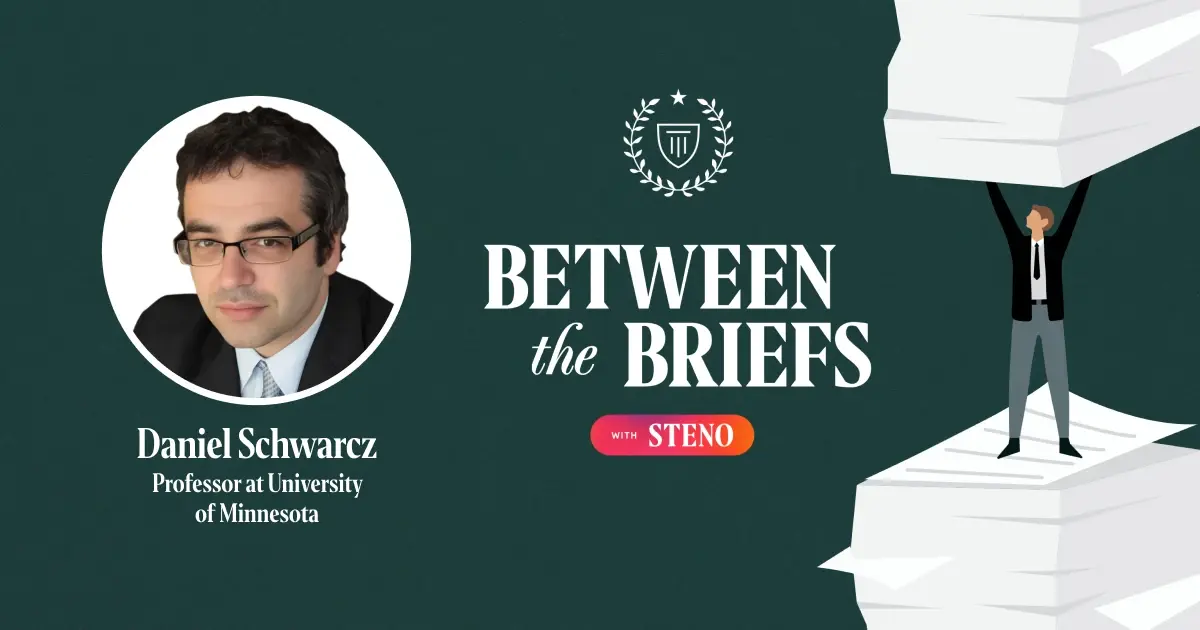
We’ve all heard that AI can make lawyers better at their jobs. But now there’s data-backed research to prove it. And now, there’s research to prove it. In the latest episode of Between the Briefs by Steno, hosts Adrian Cea and Joe Stephens welcome Daniel Schwarcz, Professor at University of Minnesota, to discuss the groundbreaking paper, “AI-Powered Lawyering” and its empirical findings on how certain AI tools are reshaping legal practice.

What You’ll Learn:

  • How retrieval-augmented generation transforms legal research

  • Why reasoning models like O1 Preview outperform traditional language models for legal analysis

  • The critical distinction between efficiency gains and quality improvements

  • How to identify tasks where AI adds meaningful value versus areas requiring caution

  • Why relying on AI without domain expertise creates ethical liability

  • The emerging labor market realities for junior attorneys


Every lawyer needs proof - this study is all the evidence you could need about AI use in today’s legal landscape.

Quotes:

  1. “We found significant improvement in efficiency, but where we really saw differences in how human lawyers who had these tools performed was in the quality of their work. Not only were the folks who participated in our study performing and providing us with legal work really quickly relative to those without AI, but they were providing better work.”

  2. “These tools are really powerful right now in terms of helping many younger lawyers with very common tasks and tasks that require a significant amount of intellectual rigor and analytical depth. Our participants in general reported increased personal satisfaction in completing the tasks with AI compared to not AI. They felt it was empowering.”

  3. “What the empirical evidence does is it grounds us in where we are now and where we were a few months ago. And that’s really important because there’s a tremendous amount of hype around AI and a tremendous amount of skepticism around AI.”

  4. “AI can give you answers that seem really good, but they may not always be really good if you are not an expert in the field. The ideal world where AI is most useful is for people who are already experts, who already understand a problem, who are using AI to help them produce an answer.”

  5. “Do I worry that AI in five years, ten years is going to really change the practice of lawyering and maybe even make certain jobs completely automated? Yeah, I do. We are trying to see if we can get an AI system that can provide effective legal advice to small business startups. That would do everything that a lawyer would do.”

Highlights

00:00
Introduction & Meeting Professor Daniel Schwarcz

02:05
AI-Powered Lawyering: Reasoning Models and Retrieval-Augmented Generation

03:27
How Significant are Productivity and Quality Gains?

08:19
Research Trade-Offs & Developing AI Use as a Skill

11:22
Retrieval-Augmented Generation & Its Role in Legal Research

About the Contributors

Joe Stephens

Joe Stephens, J.D., is Steno's Director of Legal Solutions as well as a Clinical Lecturer at Texas Tech University School of Law. With over 15 years of experience in criminal defense and public service, he founded and led Texas' largest rural public defender office, which serves a 12-county area. A graduate of The University of Texas School of Law (cum laude) and Vanderbilt University (B.A.), Stephens currently serves as a Board Member of the Texas Criminal Defense Lawyer's Association (TCDLA) and sits on multiple State Bar of Texas committees. His expertise spans the intersection of legal practice and technological innovation in the justice system.

Adrian Cea

Adrian Cea is Steno's Social Media Manager, leading content strategy, audience engagement, and digital brand-building across platforms. He also produces and co-hosts Between the Briefs, Steno's podcast covering the intersection of legal technology, court reporting, and the future of litigation. With a background spanning content creation, field marketing, and sales at companies like Sell Better and Chili Piper, Adrian brings a multi-disciplined lens to making complex legal tech topics accessible and engaging.